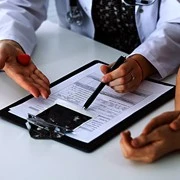
Medical Transcription Process
Have you wondered what goes on in the medical transcription process after you outsource your requirement? It begins with transcriptionists converting voice files into digital transcripts as per the prescribed format and standards. If you're a busy healthcare physician, your job is to dictate observations during the patient examination to a recording device. Later, the recordings may be sent to us. When you do so, our team will take over the medical transcription roles as per the HIPAA compliance and ensure the content is 100% accurate. We also deliver the content in less than 24 hours.
Medical Transcription Process We Follow
At Outsource2india, there are 9 steps in medical transcription and we ensure the process is like clockwork from start to finish. From start to finish we take great care to complete the transcription with care and precision. Our medical transcription steps include -
01. Establishing the SFTP for Data Transfer
We provide the client with access credentials like access ID and private key so they can securely upload the consultation recordings
02. Medical Transcription
After accessing the uploaded files, our transcriptionists will begin transcribing the dictated content into a template preferred by the client
03. Multi-level Quality Assurance Checks
The transcribed files are subjected to quality control where the content will be verified by Level-1 copy editors to ensure preliminary-level accuracy. Later, the Level-2 QA will ensure zero error
04. Proofreading Transcripts
The transcribed files are proofread to ensure there are no grammatical errors
05. Submission of Files for Review
The files that are edited and ready for upload are sent to the client for review
06. Collection of Client Feedback
The client takes a second look at the content and approves the quality or recommends additional corrections
07. Electronic Signature by Doctors
We will send the files to a doctor electronically for their digital signatures, approving the correctness
08. Uploading Final Transcripts
The final version of the file is uploaded in the SFTP and sent to the client as per the SLA
Medical Transcription Services We Offer
We transcribe a wide range of physician-dictated content that include -
Why Outsource Medical Transcription to Outsource2india?
Several benefits can be had by choosing Outsource2india as your preferred provider of medical transcription services. We have the ability to surpass expectations with service levels & capability. Reasons why it's best to outsource medical transcription services to Outsource2india include -
-
Cost Efficiency
We've always succeeded by keeping our rates economical so even small practices and clinics can take advantage without constantly looking at their budget.
-
High-quality Transcription
We offer high-quality transcriptions that are void of errors. After you receive transcriptions from us, you won't be a necessity to re-edit its content.
-
Robust Security
You can be assured about the privacy and confidentiality of patient information, as we use secure servers, 128/256-bit encryption and third-party certification while downloading files. We also ensure the secure exchange and storage of files.
-
Superior Technology and Infrastructure
Our transcriptionists work on state-of-the-art dictation technology and infrastructure, along with the latest transcription software and methodologies to provide fast and 99.9% accurate transcriptions every day.
-
Professional Transcriptionists
The medical transcription team at Outsource2india comprises of experienced language specialists, with a thorough knowledge of medical terms, expertise in the English language and exceptional typing and listening skills.
-
Lightning-fast Services
Our turnaround time is less than 24 hours because our process for medical transcription is much efficient than other service providers. With Outsource2india as your partner, you can send the files to be transcribed in the evening and be sure to print them out the very next morning.
-
ISO Certified Medical Transcription Service Provider
Being an ISO 9001:2015 certified medical transcription service company, we have over 25 years of experience in transcribing, formatting, editing and proofreading medical documents for healthcare facilities in the US, UK, Canada and Australia.
-
Scalability
Several options to scale are available with us at Outsource2india. If you lack the bandwidth to cope with extra transcription assignments, we'd be glad to offer additional resources to balance the load.
-
Round-the-clock Support
We have a support team that operates from a well-managed contact center spanned across the world. They can be contacted by phone call, email, or webchat.
Client Success Stories

Transcription Automation Services to a Group of Australian Radiologists
We aided a teleradiology group in saving nearly 40% of their operational costs and completing the transcription of process reports whose numbers were 2000 a month.
Read more
Case Study on medical transcription for Indianapolis Physicians
O2I transcribed over 3000 patient encounters in rehabilitation care for a Physicians group based out of Indianapolis.
Read moreTestimonials
I want to express my sincere appreciation for the dedication you have shown to us; truly a blessing and I thank you.
President,Medical Practicing Company, MD, USA More Testimonials »
Outsource Medical Transcription to Outsource2india
Outsource2india has remained committed to its partners by offering world-class medical transcription services. At O2I, we have 25 years of experience throughout which we have helped hundreds of healthcare facilities with multi-speciality transcription services. The biggest highlight in choosing us is the cost-benefit and the quality. We have been consistent in providing values to customers through our transcription support.
Get in touch with us now to get started on outsourcing medical transcription.

Get a FREE QUOTE!
Decide in 24 hours whether outsourcing will work for you.
Have specific requirements? Email us at: 
- 4,968,000 Transcription lines
- 504,000 Payment postings
- 450,000 Charge entries
- 288,000 Demo entries
Get a FREE QUOTE!
Decide in 24 hours whether outsourcing will work for you.
Have specific requirements? Email us at:






Key Differentiators
Software At O2I Healthcare
Specialties HIPAA Compliance HIPAA 5010
Standards Compliance CPT Coding
Compliance Healthcare
Processes Medical
Billing Process Charge
Entry Process Medical
Coding Process Medical
Claims Process FAQs on Medical Accounts
Receivable Services FAQs on Outsourcing
Claims Adjudication Services Medical
Transcription Process HL7 ICD-10 Compliance


 \
\
-
 Outsourcing Medical Billing Services - Evaluating its Impact on Your Practice
-
US-based Healthcare Research & Consulting Firm Approached O2I For Medical Transcription Services
-
Outsource2india Provided Patient Onboarding Services to a Leading Healthcare Company
-
Outsource2india Assisted a Florida-based Medical Billing Company with ICD-10 Implementation
-
Caribbean Radiologists Got STAT Reports Automation Services from Outsource2india
-
Outsource2india Helped a Medical Imaging Firm with Quick Teleradiology Services